Eigenvectors and Eigenvalues
Eigenvectors and Eigenvalues
Prerequisites
1
transformation
What is Eigenvectors and Eigenvalues
1. What is Eigenvectors and Eigenvalues?
The eigenvectors and eigenvalues are related with transformation status. Usually almost vectors on original space are change their direction. But eigenvector is not changed by transformation. Just stretch or squish the eigenvector by the size of the eigenvalues.
\[A\vec{v}\]An eigenvector is special because:
\[A\vec{v} = \lambda \vec{v}\]2. From Eigen Equation to Characteristic Equation
\[A\vec{v} = \lambda \vec{v} \quad \rightarrow \quad A\vec{v} - \lambda I \vec{v} = 0 \quad \rightarrow \quad (A - \lambda I)\vec{v} = 0\]We want a nonzero solution for $\vec{v}$.
A homogeneous system has nonzero solutions only if:
\[\det(A - \lambda I) = 0\]This is the characteristic equation. Solving it gives eigenvalues $\lambda$.
If the determinant is not zero, it means that the vetor is just a zero vetor. But the determinant is zero, there’re various case for solutions.
3. Diagonal Matrix
\[D = \begin{bmatrix} -5 & 0 & 0 \\ 0 & -2 & 0 \\ 0 & 0 & 4 \end{bmatrix}\]- The eigenvalues are exactly the diagonal entries.
- No computation needed.
The eigenvalues are
\[\lambda_1 = -5, \quad \lambda_2 = -2, \quad \lambda_3 = 4\]4. Geometric Interpret
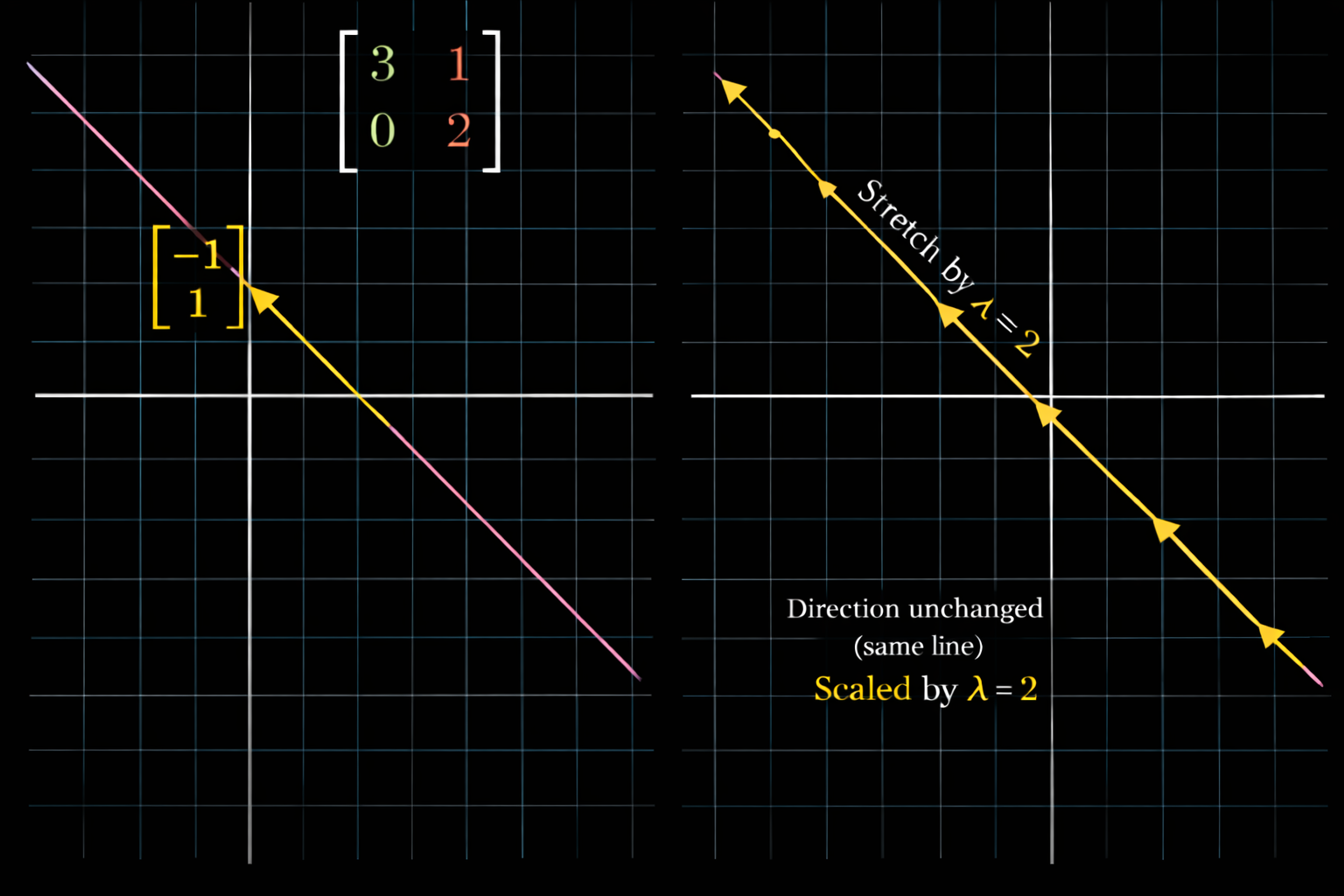
After transformation, the eigenvector is not rotate, shear and so on. just changed thing is only scale about squishing or stretching. That line is the eigenspace
5. Eigen Decomposition of Matrix
$ Av_1 = \lambda_1 v_1,\; Av_2 = \lambda_2 v_2,\; … \;Av_n = \lambda_n v_n $
$ \rightarrow A \begin{bmatrix} v_1 & v_2 & \cdots & v_n \end{bmatrix} = \begin{bmatrix} v_1 & v_2 & \cdots & v_n \end{bmatrix} \begin{bmatrix} \lambda_1 & 0 & \cdots & 0
0 & \lambda_2 & \cdots & 0
\vdots & \vdots & \ddots & \vdots
0 & 0 & \cdots & \lambda_n \end{bmatrix} $
</br> $ \rightarrow AP = PD $
If a matrix has enough independent eigenvectors:
\[A = PDP^{-1}\]Where:
- $D$ = diagonal matrix of eigenvalues
- Columns of $P$ = eigenvectors
Then:
\[A^n = P D^n P^{-1} \quad \rightarrow \quad D^n = \begin{bmatrix} \lambda_1^n & 0 \\ 0 & \lambda_2^n \end{bmatrix}\]This makes computing powers extremely easy.
Ex.
\[A = \begin{bmatrix} 0 & 1 \\ 1 & 1 \end{bmatrix}\]Its eigenvectors are:
\[\vec{v}_1 = \begin{bmatrix} 2 \\ 1 + \sqrt{5} \end{bmatrix} , \quad \vec{v}_2 = \begin{bmatrix} 2 \\ 1 - \sqrt{5} \end{bmatrix} \quad \rightarrow \quad P = \begin{bmatrix} 2 & 2 \\ 1+\sqrt{5} & 1-\sqrt{5} \end{bmatrix}\]Then:
\[A = P D P^{-1} \quad \rightarrow \quad A^n = P D^n P^{-1}\]