25. Deploy AI Model from the scratch
25. Deploy AI Model from the scratch
Deploy AI Model from the scratch
Prerequisites
1. Process from train to deploy
- Preapring Data
- MNIST
- Update Data to S3
- Model
- Train & Deploy
- Simple test
Check List
- SegaMaker Project is located in private subnet
- The Role of SegaMaker should be authorized to S3 access right
1. DATA
1-1. Preparing Data (MNIST)
- Bring data from Website or python code
1
2
3
4
5
6
7
8
9
10
11
12
13
14
15
16
17
18
19
20
21
22
23
24
25
26
27
28
29
30
import os
import torch
from torchvision import datasets, transforms

os.makedirs("mnist_pt", exist_ok=True)

transform = transforms.Compose([
    transforms.ToTensor(),
    transforms.Normalize((0.1307,), (0.3081,))
])

train_dataset = datasets.MNIST(
    root="./data",
    train=True,
    download=True,
    transform=transform
)

test_dataset = datasets.MNIST(
    root="./data",
    train=False,
    download=True,
    transform=transform
)

torch.save(train_dataset, "mnist_pt/train.pt")
torch.save(test_dataset, "mnist_pt/test.pt")

print("saved mnist_pt/train.pt")
print("saved mnist_pt/test.pt")
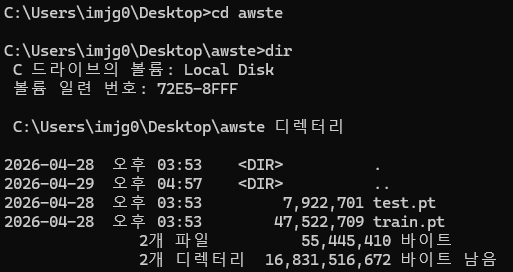
1-2. Copy data from local to S3

1
2
3
aws s3 cp "C:\Users\imjg0\Desktop\awste\train.pt" s3://my-sage-bucket-xxxxxxx-ap-southeast-2-an/train/train.pt

aws s3 cp "C:\Users\imjg0\Desktop\awste\test.pt" s3://my-sage-bucket-xxxxxxx-ap-southeast-2-an/test/test.pt
2. Create Model(In this post, model itself is not important)
model.py
1
2
3
4
5
6
7
8
9
10
11
12
13
14
15
16
17
18
19
20
21
22
23
24
25
import torch.nn as nn
import torch.nn.functional as F


class CNN(nn.Module):
    def __init__(self):
        super().__init__()

        self.conv1 = nn.Conv2d(1, 32, kernel_size=3)
        self.conv2 = nn.Conv2d(32, 64, kernel_size=3)
        self.pool = nn.MaxPool2d(2, 2)

        self.fc1 = nn.Linear(64 * 5 * 5, 128)
        self.fc2 = nn.Linear(128, 10)

    def forward(self, x):
        x = self.pool(F.relu(self.conv1(x)))
        x = self.pool(F.relu(self.conv2(x)))

        x = x.view(x.size(0), -1)

        x = F.relu(self.fc1(x))
        x = self.fc2(x)

        return x
3. Train
train.py
1
2
3
4
5
6
7
8
9
10
11
12
13
14
15
16
17
18
19
20
21
22
23
24
25
26
27
28
29
30
31
32
33
34
35
36
37
38
39
40
41
42
43
44
45
46
47
48
49
50
51
52
53
54
55
56
57
58
59
60
61
62
63
64
65
66
67
68
69
70
71
72
73
74
75
76
77
78
79
80
81
82
83
84
85
86
87
88
89
90
91
92
93
94
95
96
97
98
99
100
101
102
103
104
105
106
import os
import argparse
import torch
import torch.nn as nn
import torch.optim as optim

from torch.utils.data import DataLoader
from model import CNN


def parse_args():
    parser = argparse.ArgumentParser()

    parser.add_argument("--epochs", type=int, default=2)        # Set parameter
    parser.add_argument("--batch-size", type=int, default=64)   # Set parameter
    parser.add_argument("--lr", type=float, default=0.001)      # Set parameter

    parser.add_argument(
        "--train-dir",
        type=str,
        default=os.environ.get("SM_CHANNEL_TRAIN")
    )   # Set parameter, SM_CHANNEL_TRAIN = /opt/ml/input/data/train

    parser.add_argument(
        "--test-dir",
        type=str,
        default=os.environ.get("SM_CHANNEL_TEST")
    )   # Set parameter, SM_CHANNEL_TEST = /opt/ml/input/data/test

    parser.add_argument(
        "--model-dir",
        type=str,
        default=os.environ.get("SM_MODEL_DIR")
    )   # Set parameter, SM_MODEL_DIR = /opt/ml/model

    return parser.parse_args()


def main():
    # Set Unit
    device = torch.device("cuda" if torch.cuda.is_available() else "cpu")
    print("device:", device)

    # Set Data Set
    args = parse_args()
    train_path = os.path.join(args.train_dir, "train.pt")
    test_path = os.path.join(args.test_dir, "test.pt")
    print("train_path:", train_path)
    print("test_path:", test_path)

    train_dataset = torch.load(train_path)
    test_dataset = torch.load(test_path)
    train_loader = DataLoader(train_dataset, batch_size=args.batch_size, shuffle=True)
    test_loader = DataLoader(test_dataset, batch_size=1000, shuffle=False)

    # Set Model
    model = CNN().to(device)
    criterion = nn.CrossEntropyLoss()
    optimizer = optim.Adam(model.parameters(), lr=args.lr)

    # Model Train
    for epoch in range(args.epochs):
        model.train()
        total_loss = 0

        for images, labels in train_loader:
            images = images.to(device)
            labels = labels.to(device)

            optimizer.zero_grad()
            outputs = model(images)
            loss = criterion(outputs, labels)

            loss.backward()
            optimizer.step()

            total_loss += loss.item()

        print(f"Epoch {epoch+1}, Loss: {total_loss/len(train_loader):.4f}")

    # Model Evalucation
    model.eval()
    correct = 0
    total = 0

    with torch.no_grad():
        for images, labels in test_loader:
            images = images.to(device)
            labels = labels.to(device)

            outputs = model(images)
            _, predicted = torch.max(outputs, 1)

            total += labels.size(0)
            correct += (predicted == labels).sum().item()

    print(f"Accuracy: {100 * correct / total:.2f}%")

    # Model Save
    model_path = os.path.join(args.model_dir, "model.pth")
    torch.save(model.state_dict(), model_path)
    print("model saved:", model_path)


if __name__ == "__main__":
    main()
run_train.py
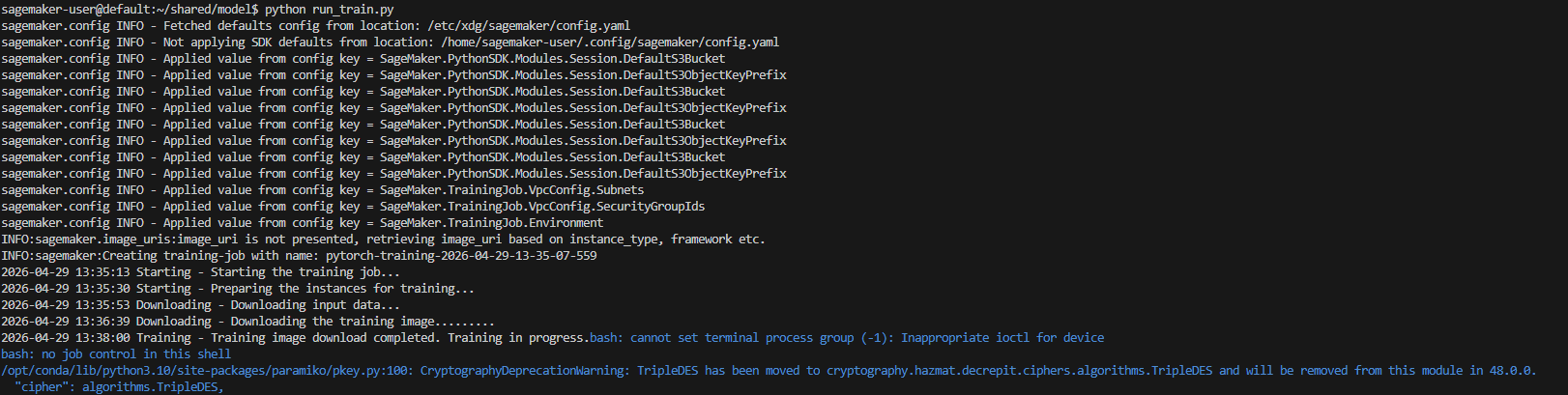
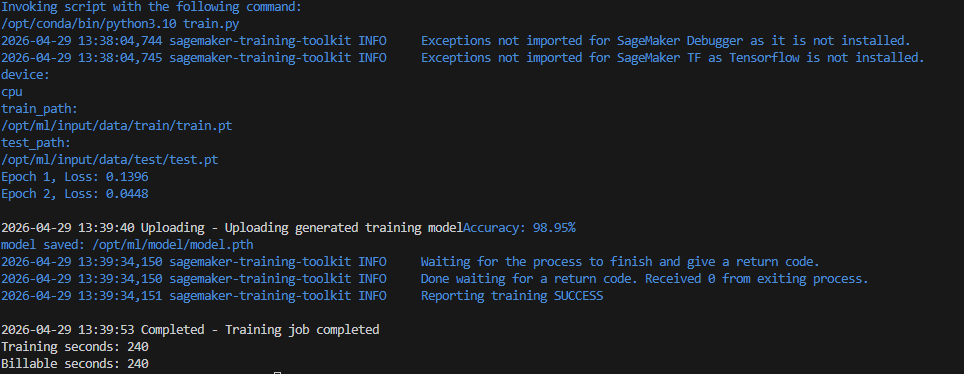
With real train python files, it’ll be running on SegaMaker.
1
2
3
4
5
6
7
8
9
10
11
12
13
14
15
16
17
18
19
20
21
22
23
24
import sagemaker
from sagemaker.pytorch import PyTorch

region = "ap-southeast-2"
bucket = "my-sage-bucket-337164669284-ap-southeast-2-an"

session = sagemaker.Session()           # create Sagemaker
role = sagemaker.get_execution_role()   # bring IAM roles

estimator = PyTorch(
    entry_point="train.py",
    source_dir=".",
    role=role,
    framework_version="2.1.0",
    py_version="py310",
    instance_count=1,
    instance_type="ml.m5.large",
    output_path=f"s3://{bucket}/mnist/output",
)

estimator.fit({
    "train": f"s3://{bucket}/train/",
    "test": f"s3://{bucket}/test/"
})
1
python run_train.py
4. Deploy
inference.py
1
2
3
4
5
6
7
8
9
10
11
12
13
14
15
16
17
18
19
20
21
22
23
24
25
26
27
28
29
30
31
32
33
34
35
36
37
38
39
40
41
import json
import torch
import numpy as np

from model import CNN

# set model
def model_fn(model_dir):
    model = CNN()
    model_path = f"{model_dir}/model.pth"

    model.load_state_dict(torch.load(model_path, map_location="cpu"))
    model.eval()

    return model

# set input
def input_fn(request_body, content_type):
    if content_type == "application/json":
        data = json.loads(request_body)
        array = np.array(data["inputs"], dtype=np.float32)
        return torch.tensor(array)

    raise ValueError(f"Unsupported content type: {content_type}")

# set predict
def predict_fn(input_data, model):
    with torch.no_grad():
        outputs = model(input_data)
        probabilities = torch.softmax(outputs, dim=1)
        prediction = torch.argmax(probabilities, dim=1)

    return {
        "prediction": prediction.numpy().tolist(),
        "probabilities": probabilities.numpy().tolist()
    }


# set output json
def output_fn(prediction, accept):
    return json.dumps(prediction), "application/json"
We should keep the name of function. When PyTorchModel will check SageMaker PyTorch inference container.
1
2
3
4
5
6
7
8
9
10
11
if hasattr(user_module, "model_fn"):
    call model_fn()

if hasattr(user_module, "input_fn"):
    call input_fn()

if hasattr(user_module, "predict_fn"):
    call predict_fn()

if hasattr(user_module, "output_fn"):
    call output_fn()
It is for sageMaker environment.
deploy.py
1
2
3
4
5
6
7
8
9
10
11
12
13
14
15
16
17
18
19
20
21
22
23
24
25
26
27
28
import boto3
import sagemaker

from sagemaker.pytorch import PyTorchModel

REGION = "ap-southeast-2"
ENDPOINT_NAME = "mnist-cnn-endpoint"
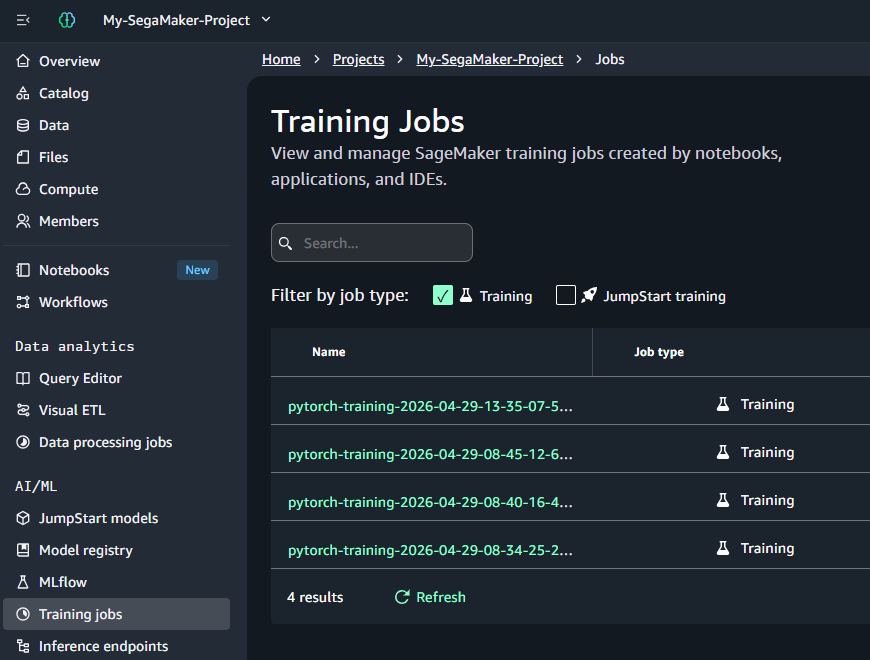
MODEL_DATA = "s3://{Bucket-Name}/mnist/output/pytorch-training-2026-04-29-13-35-07-559/output/model.tar.gz"

session = sagemaker.Session(boto_session=boto3.Session(region_name=REGION))
role = sagemaker.get_execution_role()

model = PyTorchModel(
    model_data=MODEL_DATA,
    role=role,
    entry_point="inference.py",
    source_dir=".",
    framework_version="2.1.0",
    py_version="py310"
)

predictor = model.deploy(
    initial_instance_count=1,
    instance_type="ml.m5.large",
    endpoint_name=ENDPOINT_NAME
)

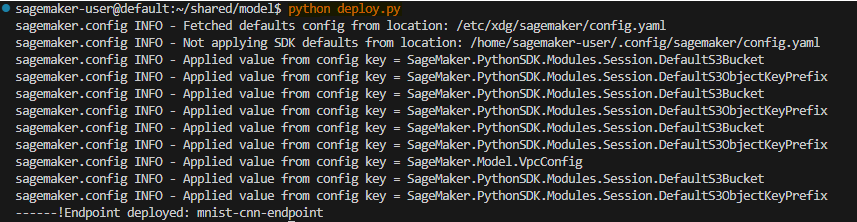
print("Endpoint deployed:", ENDPOINT_NAME)
1
python deploy.py
Add Policy: AddTag on The project Role
1
2
3
4
5
6
7
8
9
10
11
12
13
14
15
16
17
18
19
20
21
22
23
{
	"Version": "2012-10-17",
	"Statement": [
		{
		  "Effect": "Allow",
		  "Action": [
		    "sagemaker:CreateModel",
		    "sagemaker:CreateEndpointConfig",
		    "sagemaker:CreateEndpoint",
		    "sagemaker:AddTags",
		    "sagemaker:DescribeEndpoint",
		    "sagemaker:ListEndpoints",
		    "sagemaker:UpdateEndpoint",
		    "sagemaker:DeleteEndpoint",
		    "sagemaker:DescribeEndpointConfig",
		    "sagemaker:DeleteEndpointConfig",
		    "sagemaker:DescribeModel",
		    "sagemaker:DeleteModel"
		  ],
		  "Resource": "*"
		}
	]
}
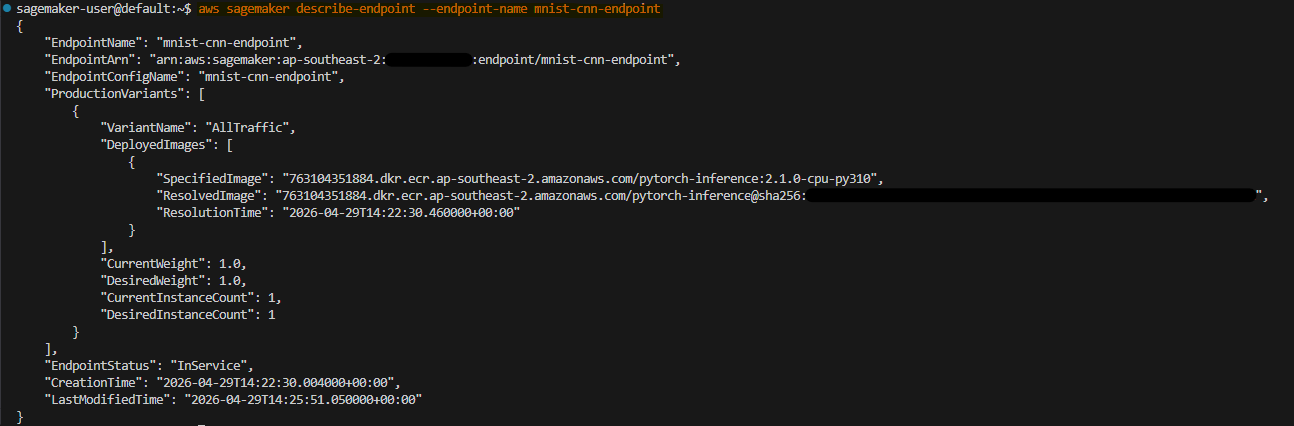
Check status of endpoint
1
aws sagemaker describe-endpoint --endpoint-name mnist-cnn-endpoint
If the name of endpoint exist, check this and delete it.
1
aws sagemaker describe-endpoint-config --endpoint-config-name mnist-cnn-endpoint
1
aws sagemaker delete-endpoint-config --endpoint-config-name mnist-cnn-endpoint
5. Simple test
test_endpoint.py
1
2
3
4
5
6
7
8
9
10
11
12
13
14
15
16
17
18
19
20
21
22
23
24
25
26
import json
import boto3
import torch

REGION = "ap-southeast-2"
ENDPOINT_NAME = "mnist-cnn-endpoint"

# dummy MNIST shape: [batch, channel, height, width]
image = torch.randn(1, 1, 28, 28)

payload = {
    "inputs": image.numpy().tolist()
}

runtime = boto3.client("sagemaker-runtime", region_name=REGION)

response = runtime.invoke_endpoint(
    EndpointName=ENDPOINT_NAME,
    ContentType="application/json",
    Accept="application/json",
    Body=json.dumps(payload)
)

result = json.loads(response["Body"].read().decode("utf-8"))

print(result)
1
python test_endpoint.py
The payload will be in request_body on input_fn parameter.
1
2
3
4
5
def input_fn(request_body, content_type):

->
data = json.loads(request_body)
array = np.array(data["inputs"])
and then call the predict_fn
1
2
3
def predict_fn(input_data, model):

input_fn -> input_data
and then call the output_fn
1
2
3
def output_fn(prediction, accept):

predict_fn -> prediction
delete endpoint
1
2
3
aws sagemaker delete-endpoint --endpoint-name mnist-cnn-endpoint
aws sagemaker list-endpoint-configs | grep mnist
aws sagemaker list-models | grep mnist
NEXT POST is DEPLOY WITH EC2
This post is licensed under CC BY 4.0 by the author.