07. Attention
Attention
Prerequisites
1
2
1. Recurrent Neural Network
2. Seq2Seq
Recurrent Neural Network have a problem that have rough 1:1 aligment. But machine translation breaks these assumptions. input/output lengths differ, different order, a target word may depend on a far-away source word.
Seq2Seq have a problem that have bottleneck of encoder. If encoder have long sequences, it is not sufficient. It still suffer from treating extremly long sequences.
What is Attention
1. What is Attention?
A Model that use Seq2Seq model but additional method that take into account hidden states at all input steps with closer attention on more relevant input tokens</span>.
Structure
\[Input \rightarrow ENCODER \rightarrow DECODER \rightarrow Softmax \rightarrow Output\]- Can be free bottleneck of decoder hidden state
- Instead of compressing everything into one vector, Decoder attends to all encoder hidden states.
2. Why use Attention?
1
All Encoder Hidden States
Each output token focuses on different input.
Attention map visualizes alignment.
3. How use Attention?
1
2
3
4
1. Query(context)
2. Value(references)
3. Key(references)
4. Attention value
$ Query $: the decoder hidden state at the t
$ Keys $: the encoder hidden state at all times
$ Values $: the encoder hidden state at all times
$ Attention Value $: the result of Attention(Q,K,V)
\(\text{Attention}(Q, K, V) = \text{weighted sum of } V\)
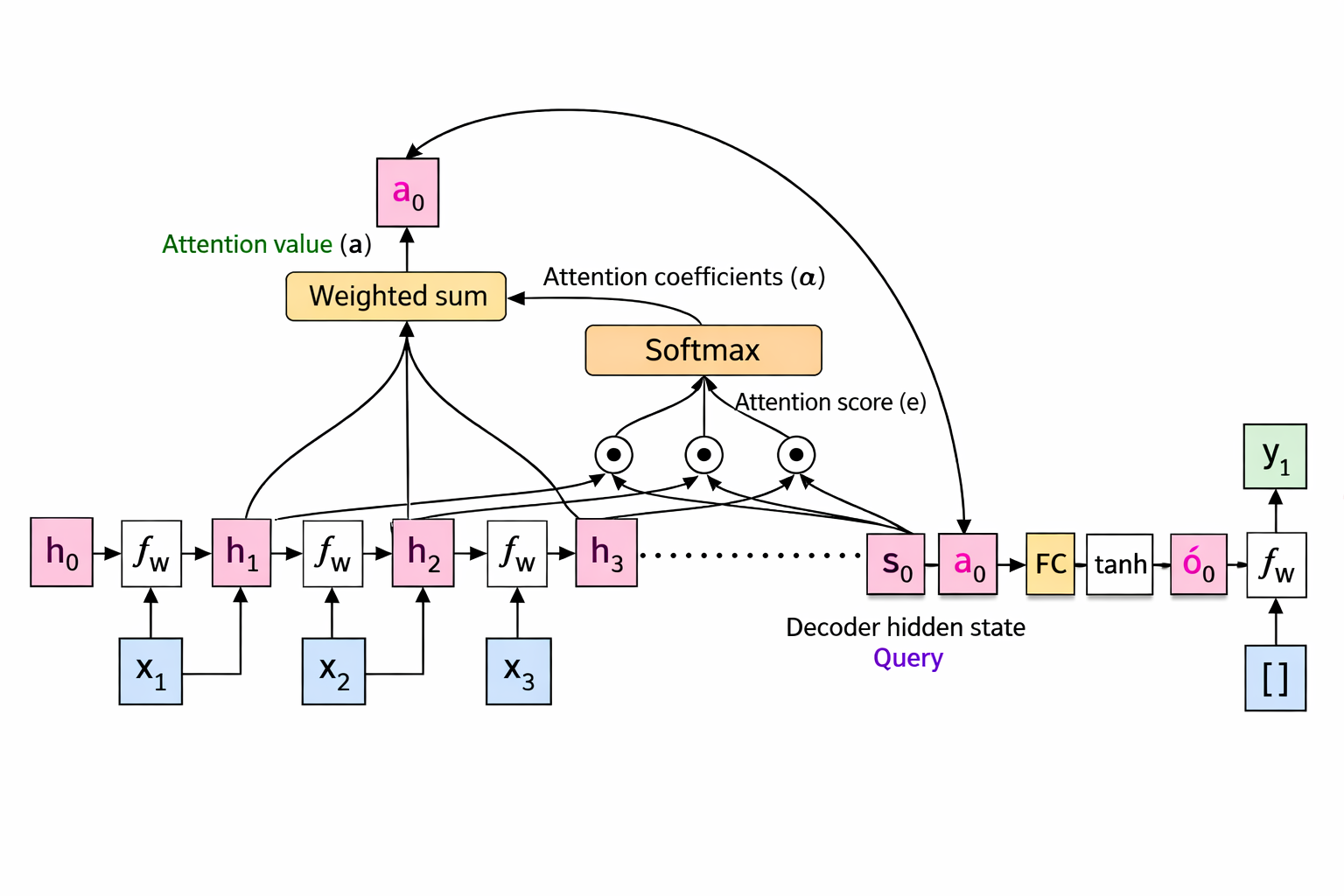
Step 1: Define Hidden States
Encoder hidden states: $ h_1, h_2, …, h_T \in \mathbb{R}^d $,
Decoder state at time t: $ s_t \in \mathbb{R}^d $
“Decoder state at time t ($s_t$)” is Query
Step 2: Compute Attention Scores
Score between decoder state and each encoder state: $ e_{t,i} = s_t^T h_i $
Vector form:
\[e_t = \begin{bmatrix} s_t^T h_1 \\ s_t^T h_2 \\ \vdots \\ s_t^T h_T \end{bmatrix} \in \mathbb{R}^T\]“Each encoder state ($h_i$)” is Key
\[\alpha_{t,i} = \frac{\exp(e_{t,i})}{\sum_{j=1}^{T} \exp(e_{t,j})}\]Step 3: Softmax → Attention Coefficients
where: $ \sum_{i=1}^{T} \alpha_{t,i} = 1 $
Step 4: Compute Attention Vector
Weighted sum:
\[a_t = \sum_{i=1}^{T} \alpha_{t,i} h_i\]This is convex combination of encoder states.
“Each encoder state ($h_i$)” is Value
“Each encoder state ($a_t$)” is Attention Value
Step 5: Combine with Decoder State
Concatenate:
\[\tilde{s}_t = \tanh(W_c [a_t ; s_t])\]where: $[a_t ; s_t]$ is concatenated vector
Output probability:
\[P(y_t | y_{<t}, x) = \text{softmax}(W_o \tilde{s}_t)\]Attention Process
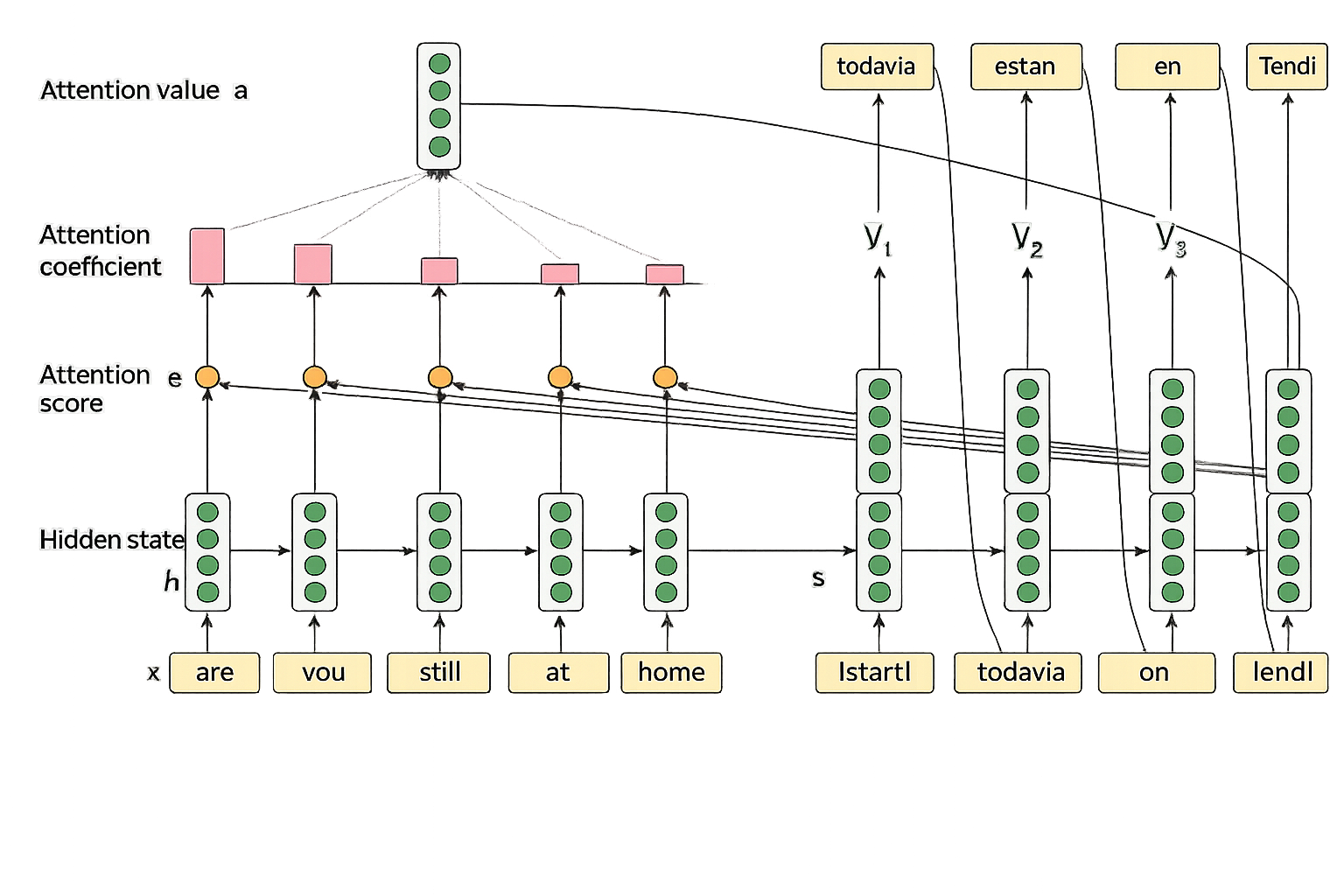
Relation Token from attention score
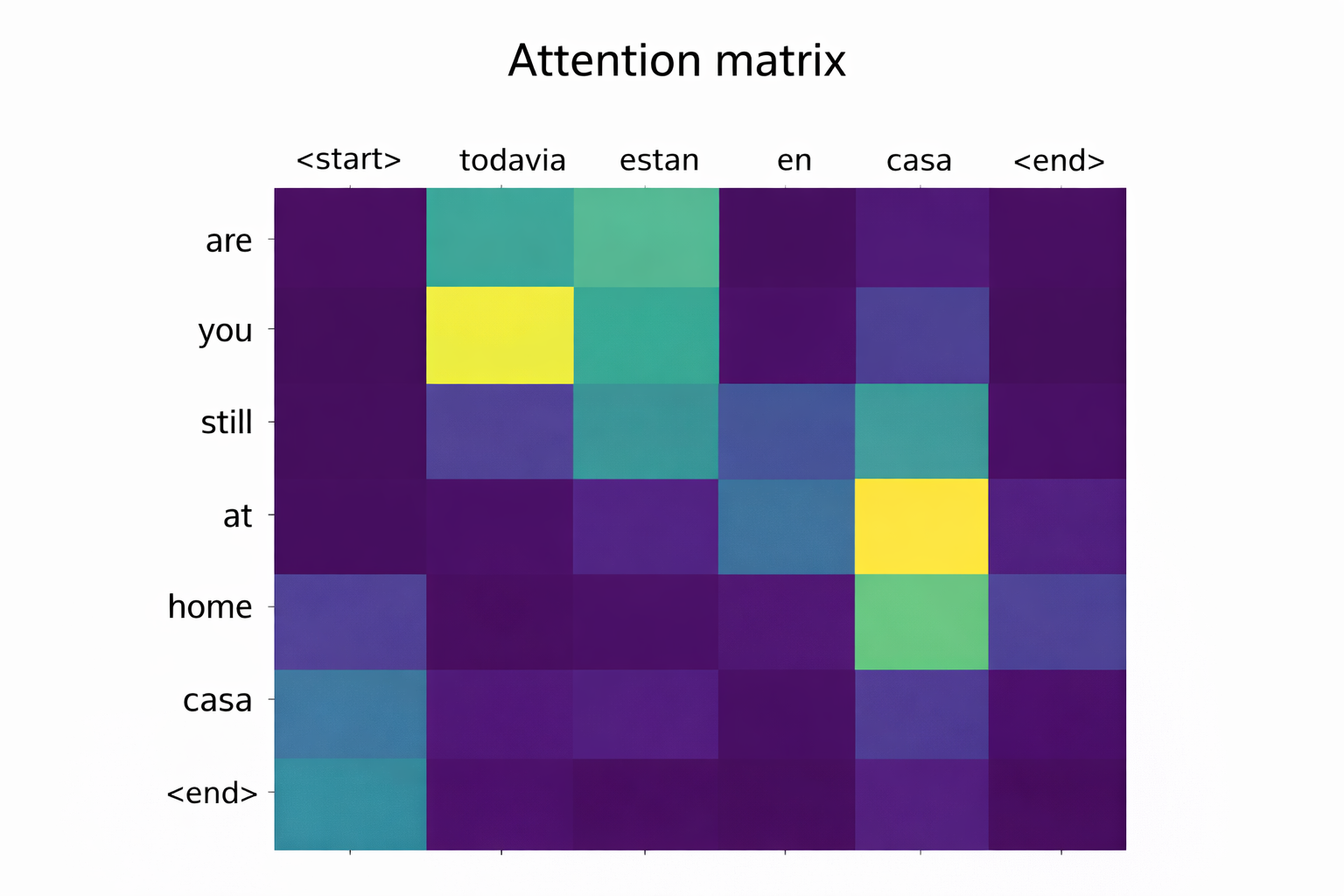
| Component | Meaning |
|---|---|
| Query | Decoder state |
| Key | Encoder states |
| Value | Encoder states |
| Attention weight | Similarity measure |
| Output | Weighted average |